Showing posts with label consumer. Show all posts
Showing posts with label consumer. Show all posts
Thursday, March 27, 2014
Consumer Credit Continued Strong Growth in November
Consumer credit continued its recent surge in November, rising $16 billion over the previous month’s level. As has been the case for some time, the majority of the growth in consumer credit is driven by gains in non-revolving credit. Consumer credit has now gained more than $10 billion per month for the past four months, after a surprise decline in July.

The gains in revolving credit were relatively modest, gaining $800 million over the month. Revolving credit has been up and down throughout 2012, rising in six and falling in five of the months.
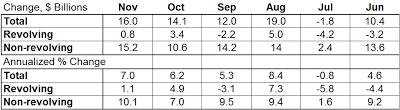
Non-revolving credit continues to drive overall growth, rising 10.1% in November ($15.2 billion). November marks the 15th consecutive gain for non-revolvoing balances. Non-revolving debt growth has been driven primarily by growth in student loans, accounting for 62% of the growth in non-revolving credit on a non-seasonally adjusted basis.

Read the Fed release.
ReadThe RestEntry..
The gains in revolving credit were relatively modest, gaining $800 million over the month. Revolving credit has been up and down throughout 2012, rising in six and falling in five of the months.
Non-revolving credit continues to drive overall growth, rising 10.1% in November ($15.2 billion). November marks the 15th consecutive gain for non-revolvoing balances. Non-revolving debt growth has been driven primarily by growth in student loans, accounting for 62% of the growth in non-revolving credit on a non-seasonally adjusted basis.
Read the Fed release.

Friday, February 28, 2014
Consumer Sentiment Rises to Four Year High
Consumer sentiment rose to its highest level in four years in May, with the University of Michigan’s consumer sentiment index reaching 79.3, up from 76.4 in April. Improvement was a result of better sentiment regarding current conditions. Consumer sentiment has now improved for nine consecutive months, after hitting historical lows in August due to debates concerning the debt ceiling.

The present conditions portion of the index improved to 87.3 in May, up from 82.9 the previous month. Future expectations dropped slightly in May, falling to 71.7, down from 72.3 the previous month.
Inflationary expectations continue to moderate. One-year inflation expectations dropped to 3.0%, down from 3.1% in April. Longer term inflation expectations inched up, with consumers expecting 3.0% inflation over the next 5 years.
ReadThe RestEntry..
The present conditions portion of the index improved to 87.3 in May, up from 82.9 the previous month. Future expectations dropped slightly in May, falling to 71.7, down from 72.3 the previous month.
Inflationary expectations continue to moderate. One-year inflation expectations dropped to 3.0%, down from 3.1% in April. Longer term inflation expectations inched up, with consumers expecting 3.0% inflation over the next 5 years.
Saturday, February 22, 2014
Consumer Prices Unchanged in December
In December the consumer price index remained unchanged for the second consecutive month. Headline CPI has failed to register positive growth for three consecutive months causing the year ago change from December 2010 to now be 3.0%. Core prices rose by 0.1% in December, moderating from November’s 0.2% increase. The year ago change for core prices held at 2.2%, an acceptable level for policymakers.

December’s slight increase in core prices was more than offset by falling energy prices, which fell 1.3% in December. Energy prices have now risen 6.6% year-over-year, significantly less than the 19.6% year-over-year gain reported in September. Food prices rose by 0.2% in December, slightly higher than the pace of 0.1% seen in the two previous months.
Price appreciation in core goods was driven by services, which saw prices rise 0.3%, an increase from the 0.2% reported last month. This was partially offset by a 0.2% fall in the price of goods, the first decline in three months.
Read the report.
ReadThe RestEntry..
December’s slight increase in core prices was more than offset by falling energy prices, which fell 1.3% in December. Energy prices have now risen 6.6% year-over-year, significantly less than the 19.6% year-over-year gain reported in September. Food prices rose by 0.2% in December, slightly higher than the pace of 0.1% seen in the two previous months.
Price appreciation in core goods was driven by services, which saw prices rise 0.3%, an increase from the 0.2% reported last month. This was partially offset by a 0.2% fall in the price of goods, the first decline in three months.
Read the report.
Friday, February 7, 2014
Consumer Sentiment Inched Up in February
Consumer sentiment rose by 0.3 points in February to 75.3, as measured by the University of Michigan’s Consumer sentiment index. The reading is significantly higher than the preliminary February reading of 72.5, indicating sentiment improved in the second half of the month. February’s improvement makes the sixth straight improvement since the index hit record lows in August on stalled debt talks in Washington.

The improvement in the index was led entirely by the future expectations portion of the index, which improved to 70.3 from 69.1. The present conditions component of the index fell from 84.2 to 83.0.
Short term inflation expectations remained unchanged at 3.3% over one year. Long term expectations rose with 5-year inflation expectations rising from 2.7 to 2.9%.
ReadThe RestEntry..
The improvement in the index was led entirely by the future expectations portion of the index, which improved to 70.3 from 69.1. The present conditions component of the index fell from 84.2 to 83.0.
Short term inflation expectations remained unchanged at 3.3% over one year. Long term expectations rose with 5-year inflation expectations rising from 2.7 to 2.9%.
Monday, December 16, 2013
Consumer Prices Remained Unchanged in July
Inflation slowed in July as consumer prices failed to appreciate for the fourth consecutive month. Falling energy prices continued to weigh on overall inflation, although less so than previous months. Core inflation slowed to 0.1% in July, after four consecutive months at 0.2%. Overall consumer prices have now risen just 1.4% from year-ago levels, down from the 1.7% reported in June.

Falling energy prices continued to restrain inflation in July, although by less than in the previous three months. Energy prices fell just 0.3% in July after averaging a drop of 2.5% over the previous three months. Food prices appreciated 0.1% in July, after failing to grow in June.
Core price appreciation was driven by a 0.1% rise in the prices of services. Goods prices were stagnant in July. Both have slowed from June where each grew 0.2%.
Read the BLS release.
ReadThe RestEntry..

Falling energy prices continued to restrain inflation in July, although by less than in the previous three months. Energy prices fell just 0.3% in July after averaging a drop of 2.5% over the previous three months. Food prices appreciated 0.1% in July, after failing to grow in June.
Core price appreciation was driven by a 0.1% rise in the prices of services. Goods prices were stagnant in July. Both have slowed from June where each grew 0.2%.
Read the BLS release.
Thursday, November 14, 2013
Consumer Delinquencies Decline Significantly in Fourth Quarter 2012
Consumer delinquencies declined significantly in last year’s fourth quarter, with bank card delinquencies falling to levels not seen since the third quarter of 1994, according to results from the ABAs Consumer Credit Delinquency Bulletin.
The composite ratio, which tracks delinquencies in eight closed-end installment loan categories, fell 17 basis points to 1.99 percent of all accounts in the fourth quarter, below the 15-year average of 2.39 percent. The ABA report defines a delinquency as a late payment that is 30 days or more overdue.
James Chessen, ABA’s chief economist, attributed the improvement to consumers’ continued efforts build a financial buffer against economic uncertainty.
“Consumers continue to carefully manage their finances in an effort to get debt levels under control and build up a secure financial base,” Chessen said. “While this conservative approach to credit may slow economic growth in the short-term, it portends stronger, more consistent growth in the future. The sharp decline in delinquencies reinforces the notion that the economic recovery has become more self-sustaining and is on a path to increased growth.”
While Chessen found the continued decline encouraging, he cautioned that future challenges could make it difficult for some consumers to meet their financial obligations.
“Make no mistake about it, a great deal of uncertainty still lingers over this economy,” Chessen said. “Furloughs from sequestration, falling disposable income and increased healthcare and regulatory costs for businesses could lead to challenges in the year ahead.”
Read ABAs full release.
ReadThe RestEntry..
The composite ratio, which tracks delinquencies in eight closed-end installment loan categories, fell 17 basis points to 1.99 percent of all accounts in the fourth quarter, below the 15-year average of 2.39 percent. The ABA report defines a delinquency as a late payment that is 30 days or more overdue.
James Chessen, ABA’s chief economist, attributed the improvement to consumers’ continued efforts build a financial buffer against economic uncertainty.
“Consumers continue to carefully manage their finances in an effort to get debt levels under control and build up a secure financial base,” Chessen said. “While this conservative approach to credit may slow economic growth in the short-term, it portends stronger, more consistent growth in the future. The sharp decline in delinquencies reinforces the notion that the economic recovery has become more self-sustaining and is on a path to increased growth.”
While Chessen found the continued decline encouraging, he cautioned that future challenges could make it difficult for some consumers to meet their financial obligations.
“Make no mistake about it, a great deal of uncertainty still lingers over this economy,” Chessen said. “Furloughs from sequestration, falling disposable income and increased healthcare and regulatory costs for businesses could lead to challenges in the year ahead.”
Read ABAs full release.
Thursday, May 23, 2013
Consumer Credit Grew 14 6 Billion in December
Consumer credit rose by $14.6 billion in the final month of 2012, driven entirely by gains in non-revolving credit. Consumer credit has now grown for five consecutive months, gaining over 10 billion each month. Gains in recent months have been driven almost entirely by the non-revolving segment. Growth from a year ago slipped slightly, falling to 5.7% in December from 5.8% the previous month.

Nonrevolving balances accounted for the entirety of December’s gain, more than offsetting a decline in revolving balances. Revolving credit fell by $3.6 billion in December, negating most of the gains seen in the previous two months. Revolving balances have been volatile in 2012, rising in just half of the months.

Nonrevolving credit grew by $18.2 billion in December, its fifth consecutive gain and the largest gain of the five. Nonrevolving credit has now grown 8.8% in the past year. On a non-seasonally adjusted basis, nonrevolving credit saw much smaller gains. Student loans continue to make heavy contributions to credit growth, accounting for about half of the non-seasonally adjusted balance.

Read the Federal Reserve release.
ReadThe RestEntry..

Nonrevolving balances accounted for the entirety of December’s gain, more than offsetting a decline in revolving balances. Revolving credit fell by $3.6 billion in December, negating most of the gains seen in the previous two months. Revolving balances have been volatile in 2012, rising in just half of the months.

Nonrevolving credit grew by $18.2 billion in December, its fifth consecutive gain and the largest gain of the five. Nonrevolving credit has now grown 8.8% in the past year. On a non-seasonally adjusted basis, nonrevolving credit saw much smaller gains. Student loans continue to make heavy contributions to credit growth, accounting for about half of the non-seasonally adjusted balance.

Read the Federal Reserve release.
Wednesday, May 22, 2013
Consumer Credit Grew by 17 7 Billion in January
Consumer credit continued to grow at a rapid pace in January, rising by $17.7 billion. Consumer credit has now grown by $54 billion in the past three months, the fastest pace since October 2000. Consumer credit has expanded for five consecutive months, and for 15 out of the past 16 months.

Non-revolving credit continues to drive the growth, expanding by $20.7 billion, the fastest pace since November of 2001. The surge in non-revolving credit was driven largely by federal government balances, which include student loans. This accounted for 85% of the monthly change in non-revolving credit. Strengthening auto sales also helped grow consumer credit.
ABA Chief Economist James Chessen said, “Student loan growth continues to dominate the increase in consumer credit, and is having a major impact on overall non-mortgage consumer debt.”

Revolving credit fell by $2.9 billion in January, the first contraction in five months. Despite the fall, revolving credit has growth by $6.2 billion in the past year.
Read the report.
ReadThe RestEntry..

Non-revolving credit continues to drive the growth, expanding by $20.7 billion, the fastest pace since November of 2001. The surge in non-revolving credit was driven largely by federal government balances, which include student loans. This accounted for 85% of the monthly change in non-revolving credit. Strengthening auto sales also helped grow consumer credit.
ABA Chief Economist James Chessen said, “Student loan growth continues to dominate the increase in consumer credit, and is having a major impact on overall non-mortgage consumer debt.”

Revolving credit fell by $2.9 billion in January, the first contraction in five months. Despite the fall, revolving credit has growth by $6.2 billion in the past year.
Read the report.
Sunday, May 19, 2013
Consumer Credit Rose 17 1 Billion in May
Consumer credit rose $17.1 billion in May. This ninth consecutive month of growth was fueled by the largest one-month gain in revolving credit since 2007. Consumer credit grew at an annualized rate of 8% and is close to prerecession levels. On the other hand, revolving credit remains below prerecession levels despite the large gain in May.

The demand for auto loans, student loans, and other types of nonrevolving credit increased at a 6.5% annual rate, or $9.1 billion. Revolving credit, the borrowing category including credit cards, rose at an 11.2% annual rate, or $8 billion.

Read the report.
ReadThe RestEntry..

The demand for auto loans, student loans, and other types of nonrevolving credit increased at a 6.5% annual rate, or $9.1 billion. Revolving credit, the borrowing category including credit cards, rose at an 11.2% annual rate, or $8 billion.

Read the report.
Saturday, May 18, 2013
Consumer Prices Saw Largest Gain in Three Years in August
Consumer prices rose 0.6% in August, their first positive reading in five months. Prior to today’s report, consumer prices had failed to appreciate since March, with the majority of the readings showing stagnant prices. August’s gain of 0.6% is the largest monthly gain in three years. Consumer prices are now 1.7% above year-ago levels.

August’s gain was driven primarily by surging energy prices, which rose 5.6% over the past month. Energy prices had receded for four consecutive months prior to August.
Core prices rose at a more moderate, but strong pace of 0.2%, up from 0.1% the previous month. Core appreciation was entirely due to a 0.1% rise in service prices, as goods prices declined 0.2%.
Read the BLS report.
ReadThe RestEntry..

August’s gain was driven primarily by surging energy prices, which rose 5.6% over the past month. Energy prices had receded for four consecutive months prior to August.
Core prices rose at a more moderate, but strong pace of 0.2%, up from 0.1% the previous month. Core appreciation was entirely due to a 0.1% rise in service prices, as goods prices declined 0.2%.
Read the BLS report.
Subscribe to:
Posts (Atom)